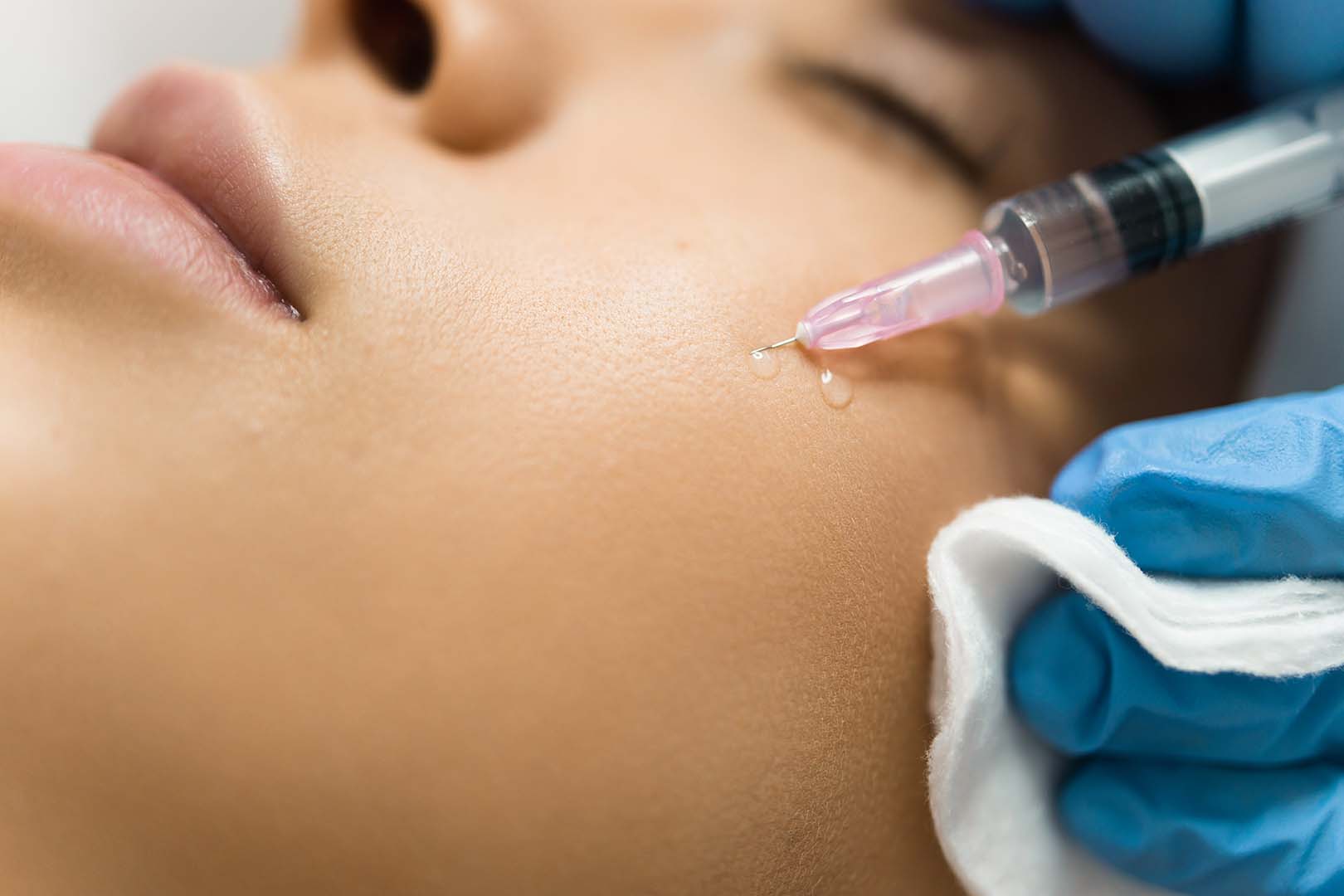
Some skin types cannot be “tricked”: even with creams, water and a strict routine, they remain dull, thin and marked by fine lines that appear too early. It is not necessarily age, it is skin quality. It is at this point — when the skin needs more than superficial hydration, but less than volume — that skin boosters come in. They are a discreet injectable treatment, designed to restore elasticity, luminosity and moisture to the skin, without altering expressions or creating artificial ‘cheeks’ or contours. The idea is not to change the face, but to improve the tissue that supports it.
What are skin boosters and why do they work differently?
Skinboosters are formulations of non-crosslinked or lightly crosslinked hyaluronic acid, specifically designed for water retention and improvement of the dermal matrix. Hyaluronic acid exists naturally in the skin and has high hygroscopic capacity — it attracts and retains water molecules, contributing to turgor, elasticity, and barrier function. When injected into micro-deposits in the dermis, it does not create visible volume as fillers do, but increases deep hydration and indirectly stimulates collagen production by improving the cellular environment. The result tends to be gradual: more homogeneous texture, smoothed fine lines and a more elastic skin feel. Science describes this as a combined effect of intradermal hydration and dermal modulation, with both functional and aesthetic impact.
Who should consider skin boosters?
The typical profile is not someone looking for drastic changes, but someone who feels that their skin has lost its ‘life’. Dry or dehydrated skin, even at a young age, can benefit when there is a loss of luminosity or a persistent feeling of roughness. For people with fine lines on their face, neck, décolleté or hands, skin boosters offer a subtle solution, especially when the goal is to maintain naturalness and preserve facial expression. In cases of loss of skin quality after chronic sun exposure, smoking or hormonal changes, this treatment can restore elasticity and skin comfort. And there is an increasingly common scenario: those who have a well-established skincare routine but feel that creams ‘don’t reach’ where they should. In these situations, intradermal hydration works as a complement, not as a substitute for the topical routine.
When they are not the best choice — limits and expectations
Despite their ‘light’ image, skin boosters are still a medical treatment and require prior assessment. They are not recommended when the main problem is advanced sagging, marked loss of volume or significant tissue loss, because they do not have deep support capacity. In these cases, other approaches may be more appropriate. They do not make sense when the expectation is an immediate and transformative result, as the effects are progressive and depend on a plan of sessions. They are also not an isolated solution for structural problems such as deep scars or deep static wrinkles. Honesty here is essential: they improve skin quality, they do not ‘erase’ years overnight. The response may vary between individuals, depending on factors such as the biological age of the skin, sun exposure, hydration, sleep, and habits such as smoking or alcohol consumption.
When to avoid: safety above all else
There are situations in which treatment should be postponed or avoided. Pregnancy and breastfeeding remain scenarios in which there is insufficient evidence to guarantee safety, so the recommendation is not to proceed. Active skin infections, exacerbated dermatitis, acute herpes, or wounds at the application site also require waiting. People with known allergies to the product’s components, active autoimmune diseases, or a history of severe reactions to injectables require individualised medical evaluation. In cases of immunosuppression, recent cancer treatments, or decompensated systemic diseases, the risk may outweigh the benefit, and prudence dictates seeking specialised guidance. There is also the technical factor: skin boosters must be applied by qualified professionals with anatomical knowledge and strict aseptic protocols. Poorly administered treatments increase the likelihood of adverse effects such as prolonged oedema, nodules, or persistent inflammation.
What to expect from the process and results
The practical experience is usually simple. After evaluation, a plan is defined that generally includes one or more sessions spaced out over several weeks. The application is done with superficial microinjections, which may cause a temporary stinging sensation or slight burning. Redness, slight swelling, or small bruises are possible and tend to resolve within a few days. The results begin to be noticed in subtle ways: a softer touch, natural glow, and a feeling of skin that is more ‘filled from within.’ Over the course of weeks, elasticity tends to improve and fine lines become less visible. Maintenance is usually periodic, as hyaluronic acid is metabolised by the body. The most important thing is for the person to understand the real goal: skin quality, not a change in features. Deep hydration creates a better backdrop for any other cosmetic procedure — or simply for ageing more comfortably and naturally.
Conclusion
Skinboosters represent a discreet and biologically logical approach for those who want to improve skin quality without altering facial features. They work by hydrating the dermis and creating an environment more conducive to elasticity and luminosity, with gradual and natural results. They have clear benefits for dry, dehydrated skin or skin with fine lines, but they do not replace other techniques when there is significant sagging or a desire for immediate transformation. Like any medical procedure, they require assessment, proper technique and realistic expectations. Knowing when it makes sense and when to avoid it is what makes this treatment safe, useful and consistent with skin health and well-being.