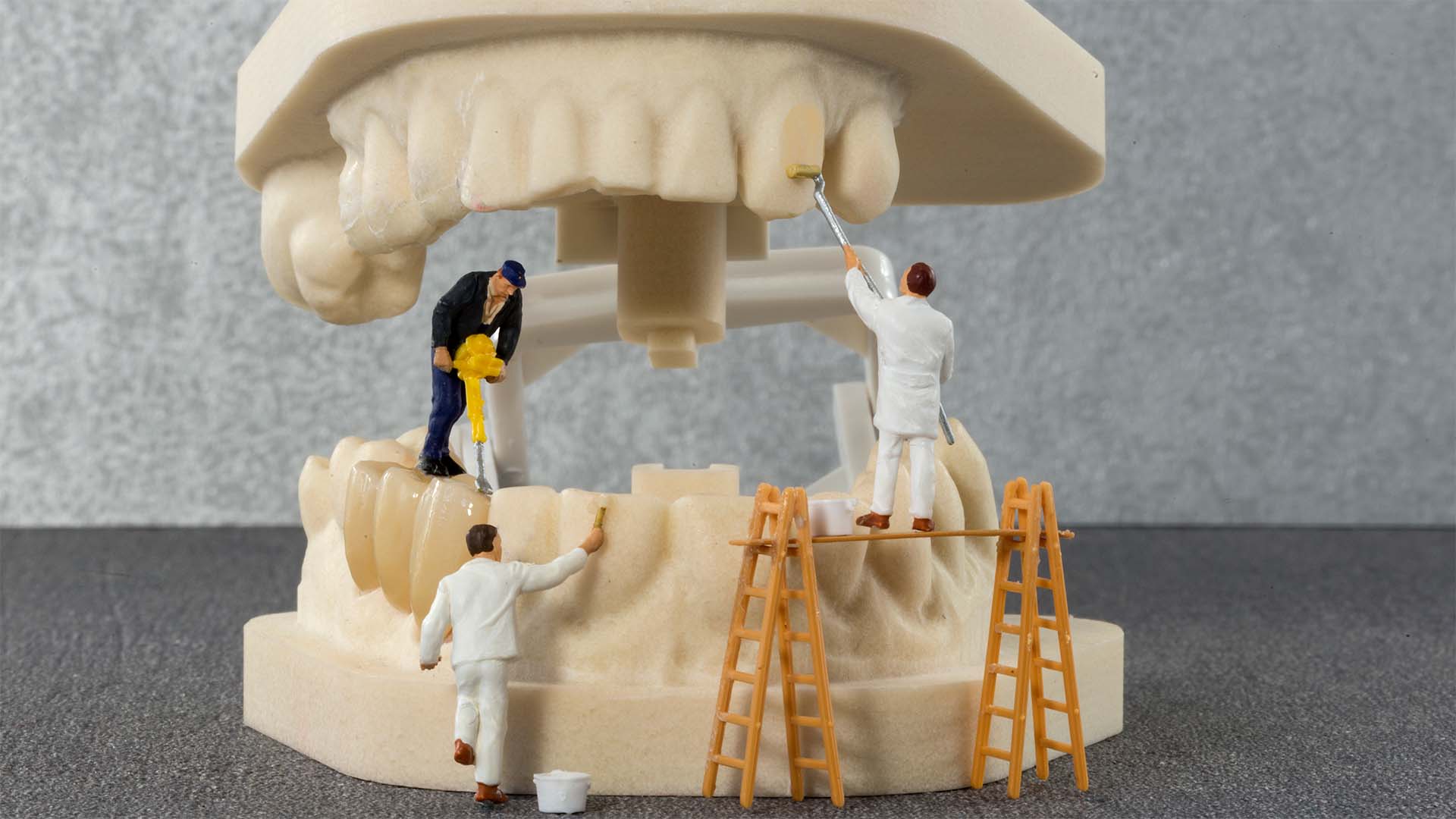
For decades, talking about dental restorations meant talking mainly about ‘filling a hole’. Today, that view is clearly outdated. Modern restoration is no longer just a repair solution, but has become a biomimetic intervention, designed to restore form, function, strength and aesthetics, while respecting the natural structure of the tooth as much as possible. This change did not happen by chance. It is the result of a profound evolution in restorative materials, supported by scientific research, materials engineering and a better understanding of dental biomechanics. The clinical impact of these innovative materials is real and visible both in the durability of restorations and in the patient experience.
From ‘passive’ restoration to dental biomimicry
Traditional restorative dentistry relied on materials whose main function was to fill space. Early amalgams and resins had good strength but little regard for the remaining tooth structure. Today’s philosophy is different. The goal is to mimic the behaviour of natural teeth by distributing forces, preserving enamel and dentine, and reducing the risk of fracture over time.
Modern restorative materials are designed to work with the tooth, not against it. Elasticity, modulus of resistance and adhesion have become parameters as important as hardness. Clinically, this translates into less invasive restorations with better marginal adaptation and greater functional longevity, especially in posterior teeth subject to high loads.
State-of-the-art composite resins: more than just aesthetics
Today’s composite resins bear little resemblance to the versions used twenty or thirty years ago. The innovation lies not only in the colour or shine, but also in the internal composition. The incorporation of nanoparticles, hybrid fillers and more stable organic matrices has improved wear resistance, colour stability and long-term polishability.
From a clinical point of view, these resins offer better adaptation to cavity walls and lower polymerisation shrinkage, reducing microleakage. This has a direct impact on the prevention of post-operative sensitivity and secondary caries. In addition, the possibility of more precise layering allows for natural aesthetic results, even in areas of high visual impact, without compromising functional strength.
Advanced adhesive systems and tooth preservation
One of the major advances in dental restoration has not only been in restorative materials, but also in adhesive systems. Effective adhesion to enamel and dentine has completely changed the clinical approach. Today, it is possible to remove less healthy tooth structure and still achieve stable and durable restorations.
Universal and multimodal adhesives have brought versatility and predictability. They enable more efficient chemical and micromechanical bonding, even in complex clinical contexts. The real impact of this evolution is the preservation of tooth structure throughout the patient’s life, reducing the need for increasingly invasive treatments in the future. Clinically, this means stronger teeth, fewer fractures and a better long-term prognosis.
Bioactive materials and the new frontier of restoration
One of the most interesting developments in recent years is the introduction of bioactive restorative materials. These materials do not merely restore, but interact with the oral environment. They release ions such as calcium, phosphate, or fluoride, contributing to the remineralisation of the adjacent tooth structure.
In a clinical context, these materials show potential in reducing recurrent caries and protecting the restoration-tooth interface. Although they do not replace good technique or proper oral hygiene, they represent an additional tool in cariogenic risk management, especially in patients with a history of frequent caries or changes in salivary flow.
Durability, maintenance, and impact on patient experience
Innovation in restorative materials is not only reflected in laboratory figures. The real clinical impact is also measured in the patient experience. More stable restorations mean fewer retreatment procedures, fewer episodes of sensitivity and greater comfort in everyday life. Colour and surface stability reduce the need for frequent polishing and contribute to a lasting aesthetic perception.
From a maintenance perspective, materials that are more resistant to wear and chemical degradation perform better over time. This is particularly relevant in an increasingly ageing population, where the longevity of restorations becomes a critical factor for overall oral health.
The future of dental restorations is already here
Talking about innovative materials in dental restorations is not talking about a distant future. It is talking about current clinical practice, based on scientific evidence and a more conservative and intelligent approach. The choice of material is no longer an invisible technical detail, but has become a central element in the success of treatment.
Modern restoration is personalised, based on the type of tooth, functional load, individual risk and patient expectations. Innovative materials allow science, technique and biology to be aligned, with a direct impact on the longevity of the restored tooth and the quality of life of those who use it every day.
What these advances mean in clinical practice
Innovative materials in dental restorations represent a profound change in the way tooth repair is viewed. It is no longer just a matter of restoring what has been lost, but of respecting, protecting and prolonging the life of the natural tooth structure. The evolution of composite resins, adhesive systems and bioactive materials has brought real clinical benefits, visible in durability, aesthetics and comfort. When properly indicated and correctly applied, these materials allow for more conservative, predictable and sustainable treatments over time. Innovation, in this context, is not a technological luxury, but an essential tool for modern, patient-centred dentistry.
References
https://doi.org/10.1016/j.dental.2010.10.020